

Pressure on healthcare continues to rise. Ageing populations, staff shortages and increasing complexity mean the current system is reaching its limits. For Willem-Jan Lamers, founder and CEO of Ambyon, that is not an abstract vision of the future, but a concrete reason to act.
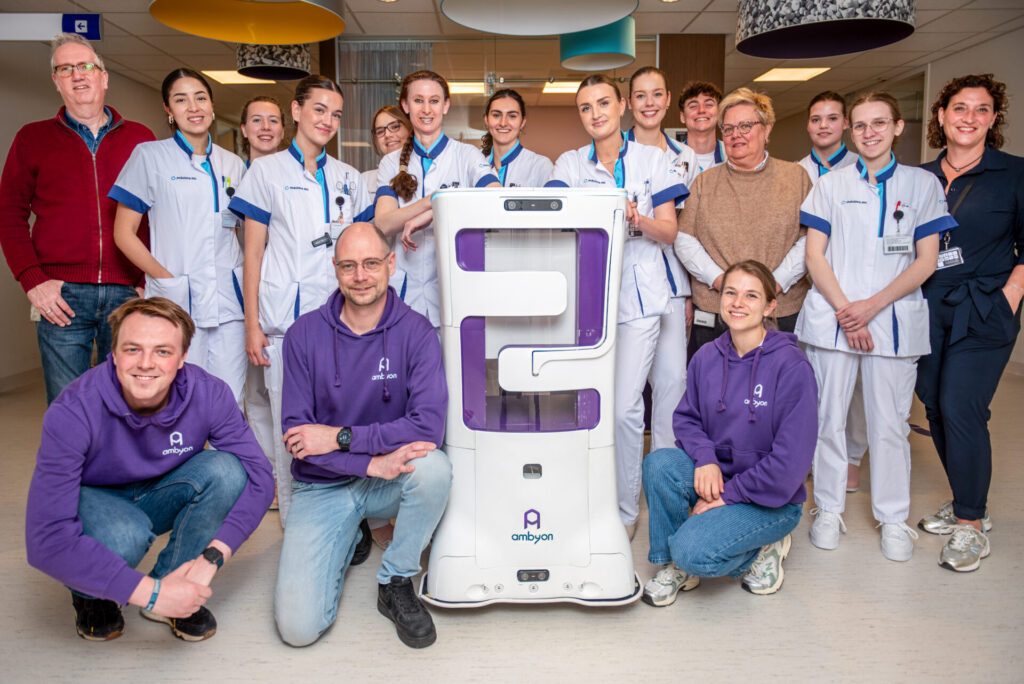
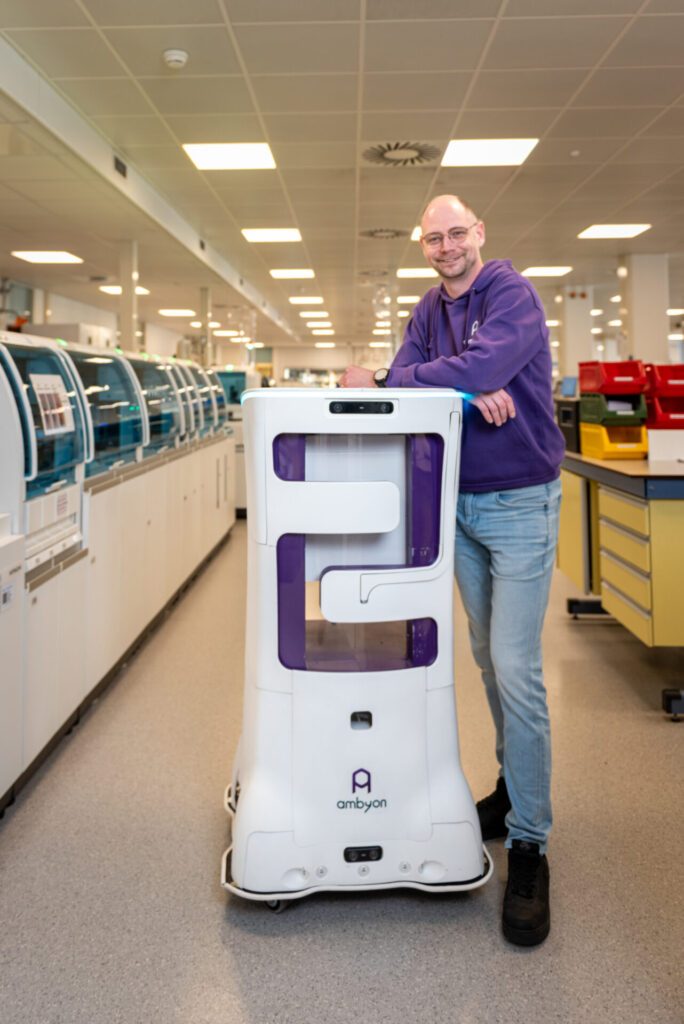
Through Ambyon, he and his team are developing the Ambyon ONE: a logistics robot for healthcare that takes over repetitive tasks in hospitals. It is not a futuristic experiment, but a practical solution that gives nurses back time for what really matters: patient care.
From personal experience to a technological mission
The seed for Ambyon was planted back in 2012, during a hospital stay at Maasziekenhuis Pantein in Boxmeer. What Lamers saw there was not an isolated incident, but an early sign of a much larger problem: too few people for too much work.
Since 2022, he has been working on Ambyon full-time. He did not start with technology, but with listening. For a year and a half, he spent time in hospitals, held hundreds of conversations and worked alongside staff on the wards. Not to sell a product, but to understand where the real bottlenecks were.
The conclusion was clear. In hospitals, a great deal of valuable time is spent on logistics: collecting medicines, transporting samples, looking for equipment, moving linen. All essential tasks, but ones that do not add direct value to patient care. That is exactly where Ambyon is focusing its efforts.
Robotics that adapts to healthcare
The Ambyon ONE is designed to function in existing healthcare environments without major changes. No complex infrastructure overhaul, but integration into the reality of the hospital. Acceptance by care teams is crucial. Lamers saw in earlier generations of healthcare robots that frustration quickly arises when systems behave unpredictably. That is why user experience is an integral part of the development process. Within the twelve-person team, there is even a nurse working as a Nurse Innovator to embed that practical knowledge in a structural way.
Co-creation as a development model
Ambyon works through what it calls a Frontrunners Consortium. Hospitals help further develop the product and take a financial stake in this early phase. That requires courage. It means investing without full certainty about the outcome.
According to Lamers, that is precisely the strength of the model. You cannot develop a complex physical product in isolation from practice. Co-creation leads to a solution that genuinely lands within a healthcare organisation. Without that intensive collaboration, innovation too often gets stuck in pilot projects.
Talent follows purpose
At the moment, Ambyon is based on the campus of Eindhoven University of Technology. That choice is deliberate. Being close to robotics expertise creates a strong inflow of technical talent. In a region where many companies struggle to find people, Ambyon receives more applications than it can take on.
Lamers attributes that success not only to location, but also to culture. Working at Ambyon means choosing purpose over salary. Responsibility, autonomy and social impact are central.
At the same time, he recognises that Eindhoven is a technological metropolis. Healthcare itself is less prominent there. A campus with a strong life sciences profile could add value, provided the right mix of organisations is present.
“If healthcare is to remain future-proof,
technology will have to become a structural part of the solution.”
Location as a strategic factor
When Lamers ranks priorities for future accommodation, he is clear: geographic location is by far the most important factor. Cost and representativeness come next. Sustainability matters too, but at the current start-up stage it is secondary to survival.
For technical robotics talent, the Boxmeer region is less of an obvious draw than Eindhoven. That could shift in a later phase of growth, for example as functions such as customer success, sales and operations become a larger part of the business. At that point, there may be room for a second location or a phased relocation.
What remains essential for Ambyon is proximity to partners and customers. Collaboration around physical products requires physical meetings. Teams calls are not enough when you are working together on an integrated solution.
The workplace of the future in healthcare technology
Looking ten to fifteen years ahead, Lamers is unequivocal. In hospital care, far-reaching automation and robotics are inevitable. Not as an end in themselves, but as a necessary condition for keeping healthcare affordable and workable. That also means a shift in the kind of talent the sector needs: more technological expertise, more integration between medical and technical disciplines, and organisations that are used to working in ecosystems.
For campuses focused on life sciences and health, that creates a clear challenge. They need to offer more than space. They need to create an environment in which technology, clinical practice and entrepreneurship reinforce one another. Serendipity matters, but so do accessibility, facilities and representativeness.
Technology as a structural solution
Ambyon is still in an early phase. The market is moving, competition is developing, and success is never guaranteed. But for Lamers, the direction is unmistakable. If healthcare is to remain future-proof, technology will have to become a structural part of the solution. Not as a replacement for people, but in support of them, so that healthcare professionals can focus on their core task.
For innovative companies, that means one thing: choosing the right place to grow is not a side issue. It is a strategic decision that directly affects impact.